Amethyst isn’t just another pretty purple gem. Its deep violet hues and centuries-long lore have marked it as a stone of clarity, protection, intuition, and spiritual transformation. And it’s supposed to stop you getting drunk! Allegedly.
But what is amethyst (and where does its purple come from)?
GEMMOLOGICAL PROPERTIES OF AMETHYST
Color Purple (sometimes Green)
Family Quartz
Mohs Scale Hardness 7
Specific Gravity 2.65
Refractive Index 1.532 – 1.554
Lustre Vitreous
Crystal System Trigonal
Transparency Transparent to translucent
Chemical Formula SiO2
Amethyst History & Lore
Across cultures and ages, amethyst has carried various symbols, used in amulets and jewellery as protective talismans. Samples of it set into gold rings have been uncovered in burial sites as far back as 2,400 BCE.
Ancient Egypt: The Book of the Dead encouraged Egyptians to turn amethysts into heart-shaped amulets for burial.
Romans: Purple was considered a regal colour and various emperors banned the wearing of purple togas by anyone except them, however, associated with royalty and nobility, amethyst was a popular gemstone among the Roman elite.
Medieval Europe: Medieval warriors and healers wore amethyst for courage, calm, and clarity in battle.
Christian tradition: Bishops often wore amethyst rings as symbols of spiritual wisdom and goodwill.
Royalty & luxury: Deep purple amethyst was once valued as highly as diamonds, adorning crowns and regalia.
These associations weave amethyst into histories of sobriety, spiritual authority, protection, and noble status, making it both a gem of beauty and deep symbolic weight.
Did you know…..
Amethyst is mentioned as one of the twelve stones on the biblical ‘Breastplate of Aaron’ supposed to represent the twelve tribes of Israel (read my December blog for more about this)
The Meaning & Symbolism of Amethyst
Amethyst’s spiritual meaning tends to focus on clarity of mind, calm strength, and higher awareness:
Mental Clarity & Sobriety
Historically, amethyst was believed to sharpen the mind and guard against chaos, overindulgence, and confusion — a “stone of sobriety” in both literal and metaphorical senses.
Peace, Calm & Emotional Balance
Many view amethyst as an emotional anchor, believed to soothe stress, dissipate anxiety, and bring peace during times of turmoil. It is also supposed to relieve insomnia by placing a tumbled stone under your pillow at night.
Spiritual Insight
Amethyst has long been associated with intuition, meditation, and spiritual connection, particularly linked to the third eye and crown chakras.
Protection & Purification
In several cultures, amethyst was thought to purify the aura, shield from negative influence, and deepen inner resilience.
All of this makes amethyst a gemstone worn not only for its colour and charm, but for its metaphysical properties.
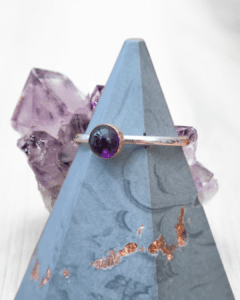
Amethyst in Jewellery: Everyday Magic
Did you know….
Amethyst can be found in the Crown Jewels of several countries. For example, a large cabochon amethyst sits above the Cullinan I diamond (the second largest cut diamond in the world) in the Imperial Sceptre of the British Crown Jewels.
Mining Amethyst
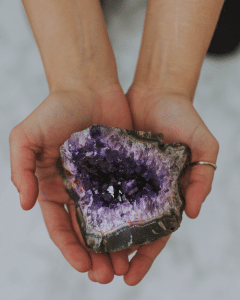
If, like me, you fancy a trip to a gemstone mine then put the open-to-the-public Maissau Amethyst Mines in Austria on your list. The Amethyst mines in Brazil are considered to be the best in the world although it is also found in Zambia, Uruguay, Russia, Sri Lanka, Mexico, and the US state of Arizona.
Amethyst as a Birthstone
Amethyst is the traditional birthstone for February, symbolising peace, inner strength, and spiritual grounding — qualities especially meaningful at the heart of winter’s introspective stillness.
It’s also associated with the star sign Pisces, intuition and spirituality.
Amethyst has an association with St Valentine, the patron saint of romantic love, who apparently wore an Amethyst ring carved with the image of Cupid, and if this is the case this could be why Amethyst became February’s birthstone.
It is also the official gemstone for Wednesday and the 6th and 17th wedding anniversaries.
Caring for Your Amethyst
Caring for Your Amethyst
Like all quartz gems, amethyst enjoys gentle care:
Avoid prolonged exposure to intense sunlight (the colour can fade over time).
Clean with mild soap, warm water, and a soft cloth.
Store separately from harder stones to protect its surface.
Did you know….
The world’s largest amethyst geode, “The Empress of Uruguay”, stands at 3.27m tall and weighs 2.5 tonnes. It was discovered in 2007 and took 3 months to excavate.
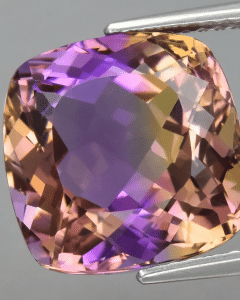
When is amethyst NOT amethyst….when it’s CITRINE
Why Amethyst Still Captivates
Amethyst isn’t just a purple gemstone — it’s a story carved in crystal. A gem that invites calm in hectic moments and clarity in foggy minds.
Whether you wear it for meaning, beauty, or both, amethyst continues to show its ancient legacy through modern adornment and I simply adore using it in my gemstone jewellery.
Did you know…
Amethyst was once as expensive as Emerald! Amethyst was seen as one of the cardinal gemstones up until the 1700s (along with diamonds, sapphires, rubies and emeralds). This however changed with the discovery of large amethyst deposits in Brazil which made the stone widely available causing the value to drop.
SOURCES