Birthstones feel like one of those things that have always existed — shiny gems tied to the month of our birthday. But the truth is far older and stranger and takes us through deserts, temples and centuries.
Birthstones aren’t just jewellery. They’re what happens when myth and memory meet marketing!
Twelve Stones, Twelve Tribes, and a Beginning Set in Stone
Most stories about birthstones trace the origin of them to one object: the Breastplate of Aaron — a ceremonial piece said to hold twelve gemstones arranged in four rows of three, with each stone representing one of the twelve tribes of Israel as follows
These stones were apparently set in gold and had the twelve sons of Israel’s names engraved on them.
They were identifiers, protectors, sacred symbols set into metal. But the number twelve became a thing: twelve tribes, twelve months, twelve zodiac signs. A structure that would one day be woven into the idea of birthstones.
Vedic astrology and Eastern traditions
When Stones Became Monthly Guardians
The association of the 12 breastplate gems with the 12 months of the year and the 12 signs of the zodiac has been credited to two 1st and 5th century AD scholars, Flavius Josephus and St. Jerome. It was intended that each person would own all of the 12 stones and wear them on the corresponding month. It was believed each stone had a specific energy or protection as the year turned. It wasn’t about “your” stone. It was about the stone you needed to wear.
From Seasonal Talismans to Personal Identity
Between the 16th and 18th centuries, birthstones began to resemble the system we recognise now. Different regions linked stones to different months and although the lists never fully agreed the idea took hold. A birthstone became something more personal.
By the early 20th century, the most modern birthstone chart as we know it was starting to appear as a result of marketing and money!
In the late 1800’s the famous New York jewelry store Tiffany & Co started marketing birthstone jewellery. Called “natal stones” each gemstone was associated with a certain virtue. Tiffany & Co published pamphlets with short Victorian poems and sales of birthstone jewellery started to grow.
But it wasn’t until 1912 when The American National Retail Jewelers Association (now Jewelers of America) met and (like De Beers and Diamonds – read my blog) created a formal system for marketing specific gemstones to each month which was influenced by all the older traditions above.
This list was the first to create a consistent, widely adopted American standard for jewellers.
American vs. UK Birthstones
Of course, we had to be different to the US, and the modern British birthstone chart was created by the National Association of Goldsmiths in Britain in 1937 and here we have it – a chart still used today.
Which is your birthstone? Do you even like your birthstone? Mine is Diamond and I adore mine. So much so that I have decided to spend 2026 learning more about them and gemmology in general. As a result, each month I will be sharing a birthstone with you, so you know more about the gem, its history, its properties (both physical and metaphysical) and the pieces I make with that gem.
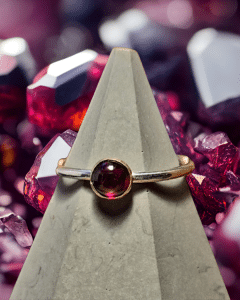
To whet your appetite here’s a little about January’s birthstone – Garnet.
January’s Deep Red Legacy
This beautiful red stone gets its name comes from the Latin ‘granatus’ which is a reference to their resemblance to pomegranate seeds! Archaeologists have found garnet in Bronze Age burials; ancient Egyptians carved it into protective amulets and Romans used it in signet rings and seals as symbols of power, identity, and permanence. But perhaps one of my favourite uses of Garnet must be the Sutton Hoo treasure.
Why Birthstones — and Gems — Still Matter